Originally founded by the Mon people Chiang Mai is one of the eldest cities in Thailand.
King Mengrai of the Thai-people conquered the kingdom Haripunchai of the Mon in 1281 and expanded Chiang Mai to become his kingly residence.
There are a lot of sites in the town that date back to it's rich and prosperous past, mainly influenced by buddhism.
Chiang Mai has an incredible amount of temples, there are over 200 buddhist temples in and around the city.
I fell in love with one which is a bit smaller and appears rather nondescript in comparison with the grand buildings around it:
Wat Pan Tao, directly sited at Chiang Mai's main road used to be the dormitary of the monks in medieval times and was turned into a temple about 300 years ago.
It is completely made out of wood with the most intricate carvings. the wood had been restored completely in 1797.
Yesterday we passed it when were walking through town and Benny, our youngest son (5) took a nap so we decided to rest in the park behind the temple.
Me and my son Kai (8) started to draw the temple. That's what we came up with:
When Benny woke up he also joined us drawing. Here's his drawing:
The atmosphere was amazing. People were stopping to watch, but very respectfully, smiling at us in an encouraging way.
Even one of the monks brought a camera and took a photo of the three of us.
Samstag, 16. August 2014
Tuk Tuk
Tuk Tuk is the name of the auto rickshaw in Thailand.
We already drove around with them and it's a sheer fun ride.
This morning I sat down to sketch a Tuk Tuk that I had spotted already yesterday and which seemed a good object to draw.
While I was in the process of sketching the driver of a second Tuk Tuk came and my object was bound to be taken away to the garage.
Luckily the second driver had parked it's vehicle next to the first one and I could get some details from the second one while the first had been turned around and tossed away by the first driver and a friend of him.
The second driver then got interested in my drawing and peeked over my shoulder while asking something in thailandish.
I tried to start a conversation in english realising that he was bound to drive away with the second Tuk Tuk while the first one had been gone already.
When he learned that I am from Germany he began talking about football. At least we found a way of comunication.
"World Cup!"
he said, our thumbs got up.
"Müller, Schweinsteiger, Götze" thumbs up.
"Germany won!" "Yes," I replied "after twentyfour years, you know." trying to relativise it.
The driver laughs. "After twentyfour years? Really?"
He points at my drawing, gives me another thumb up and drives off...
I finished some linework at our guesthouse.
We already drove around with them and it's a sheer fun ride.
This morning I sat down to sketch a Tuk Tuk that I had spotted already yesterday and which seemed a good object to draw.
While I was in the process of sketching the driver of a second Tuk Tuk came and my object was bound to be taken away to the garage.
Luckily the second driver had parked it's vehicle next to the first one and I could get some details from the second one while the first had been turned around and tossed away by the first driver and a friend of him.
The second driver then got interested in my drawing and peeked over my shoulder while asking something in thailandish.
I tried to start a conversation in english realising that he was bound to drive away with the second Tuk Tuk while the first one had been gone already.
When he learned that I am from Germany he began talking about football. At least we found a way of comunication.
"World Cup!"
he said, our thumbs got up.
"Müller, Schweinsteiger, Götze" thumbs up.
"Germany won!" "Yes," I replied "after twentyfour years, you know." trying to relativise it.
The driver laughs. "After twentyfour years? Really?"
He points at my drawing, gives me another thumb up and drives off...
I finished some linework at our guesthouse.
Donnerstag, 14. August 2014
Wat Doi Suthep
The rainy season lived up to its name today when we took a trip to the Wat Doi Suthep, a buddhist temple built in 1383, 20 km west of Chiang Mai on the mountain Doi Suthep.
The kids and my parents in law willingly joined to climb the 309 steps to the temple's gates although it was pouring.
Inside the temple we walked around barefooted and I tried to find a "dry spot" to sit down for a watercolour sketch.
Even when I eventually found one it was pretty hard to work with watercolours: not even the rain but also the air moisture totally changed the paper's quality and it already felt as if it was soaked (I guess it was...)
Heavy hearted I decided to finish the drawing in the evening after a reference photo I took on spot.
So: no real urban sketching there ;-)
This just a small adjoining building, the whole building with the completely copper plated chedi in the inner temple are of incredible beauty.
The kids and my parents in law willingly joined to climb the 309 steps to the temple's gates although it was pouring.
Inside the temple we walked around barefooted and I tried to find a "dry spot" to sit down for a watercolour sketch.
Even when I eventually found one it was pretty hard to work with watercolours: not even the rain but also the air moisture totally changed the paper's quality and it already felt as if it was soaked (I guess it was...)
Heavy hearted I decided to finish the drawing in the evening after a reference photo I took on spot.
So: no real urban sketching there ;-)
This just a small adjoining building, the whole building with the completely copper plated chedi in the inner temple are of incredible beauty.
Mittwoch, 13. August 2014
Boutique House Nipha
We arrived in Chiang Mai, Thailand and stay at a lovely Guest house.
Here's the first quick color sketch I did this evening:
The view on the backyard of the hotel, overgrown by tendrils and leaves and lit by lanterns from below, which I found fascinating. Still: in the face of so many details I totally panicked, searching for visual shortcuts wherever I could find them...
I'm just happy that on his new Video even James Gurney assures that in the face of a detailed subject this is the common emotion one can expect...;-)
Here's the first quick color sketch I did this evening:
The view on the backyard of the hotel, overgrown by tendrils and leaves and lit by lanterns from below, which I found fascinating. Still: in the face of so many details I totally panicked, searching for visual shortcuts wherever I could find them...
I'm just happy that on his new Video even James Gurney assures that in the face of a detailed subject this is the common emotion one can expect...;-)
Samstag, 9. August 2014
Poul's attic finds
My friend Poul finds a lot of weird critters while he's runmaging in his attic...
Today I show you how he finds them.
He even looks for them at the breakfast table.
And he does need quite some magnifying glasses...they are tiny.
He works on a very tough and smooth watercolour paper with tiny brushes.
The sepia-tone of the backgrounds is made with a pretty strong instant coffee and then he works with watercolour and gouache on top of that.
He found an antique photo album at the flea market where he collects his finds in.
I was indeed blown away by the details and accuracy he manages to maintain in this scale.
Here you can see the album and a new attic find next to the photo-album in comparison with a 1 € coin:
This is how the album looks inside:
Everyday he finds new stuff in his attic and the pages fill rapidly...can't wait to see the finished book!
Thanks so much, Poul and Teresia for the wonderful days and your friendship!!
Today I show you how he finds them.
He even looks for them at the breakfast table.
And he does need quite some magnifying glasses...they are tiny.
He works on a very tough and smooth watercolour paper with tiny brushes.
The sepia-tone of the backgrounds is made with a pretty strong instant coffee and then he works with watercolour and gouache on top of that.
He found an antique photo album at the flea market where he collects his finds in.
I was indeed blown away by the details and accuracy he manages to maintain in this scale.
Here you can see the album and a new attic find next to the photo-album in comparison with a 1 € coin:
This is how the album looks inside:
Everyday he finds new stuff in his attic and the pages fill rapidly...can't wait to see the finished book!
Thanks so much, Poul and Teresia for the wonderful days and your friendship!!
Freitag, 8. August 2014
Poul in Berlin
My friend Helmut Poul Dohle and his lovely wife Teresia are visiting us in Berlin.
Yesterday we made an expedition exploring Adolph Menzel's work.
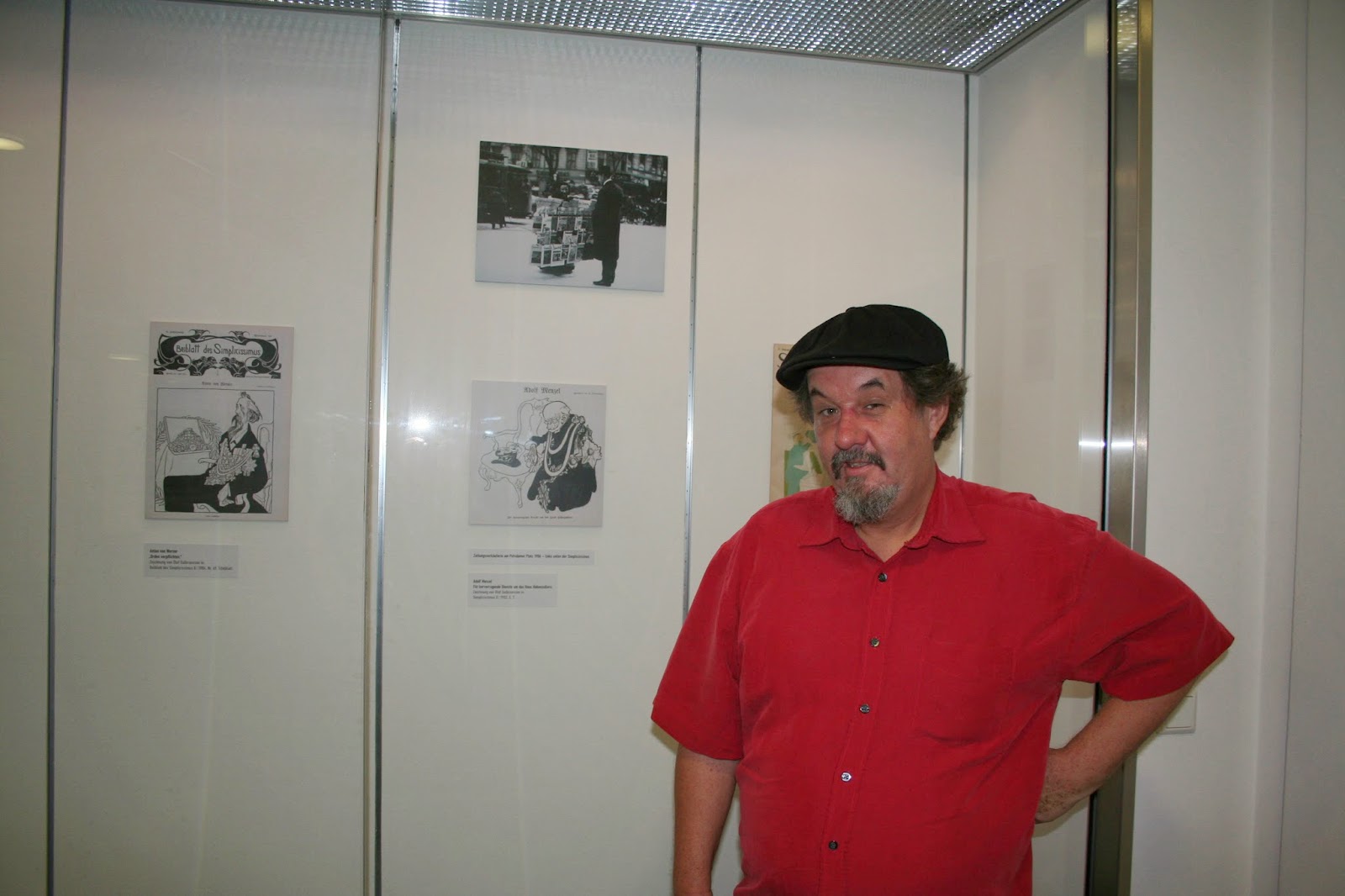
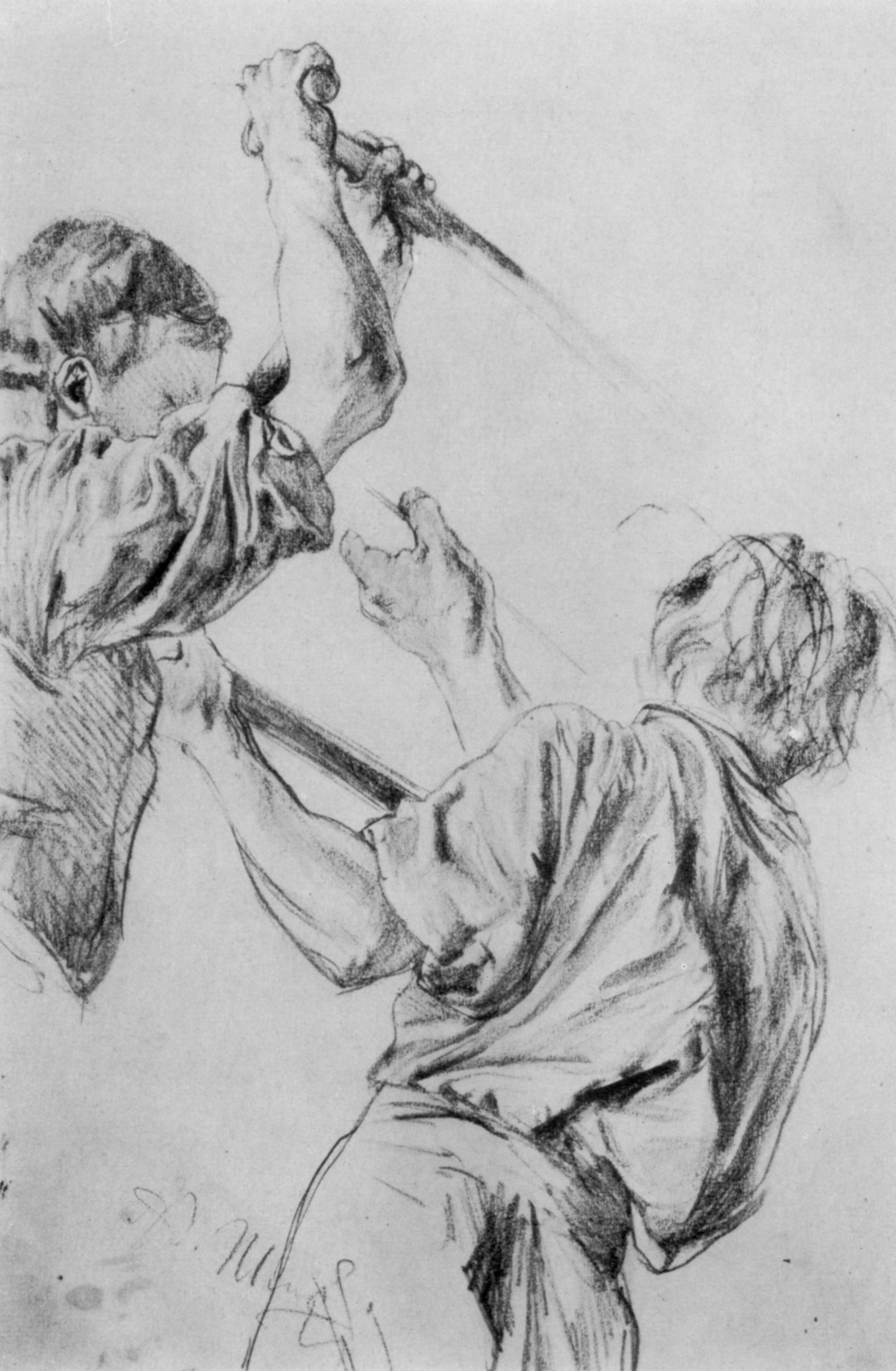
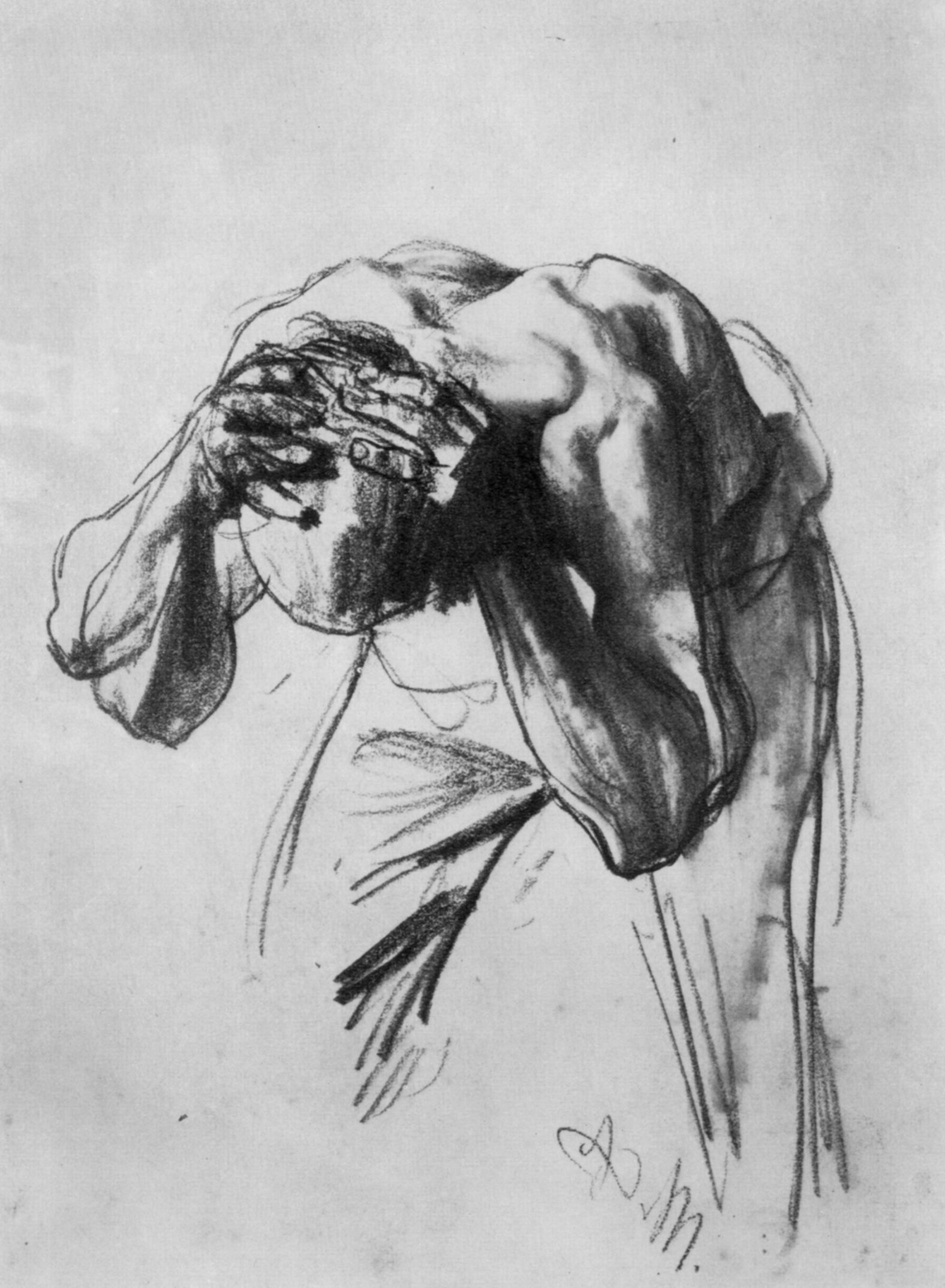
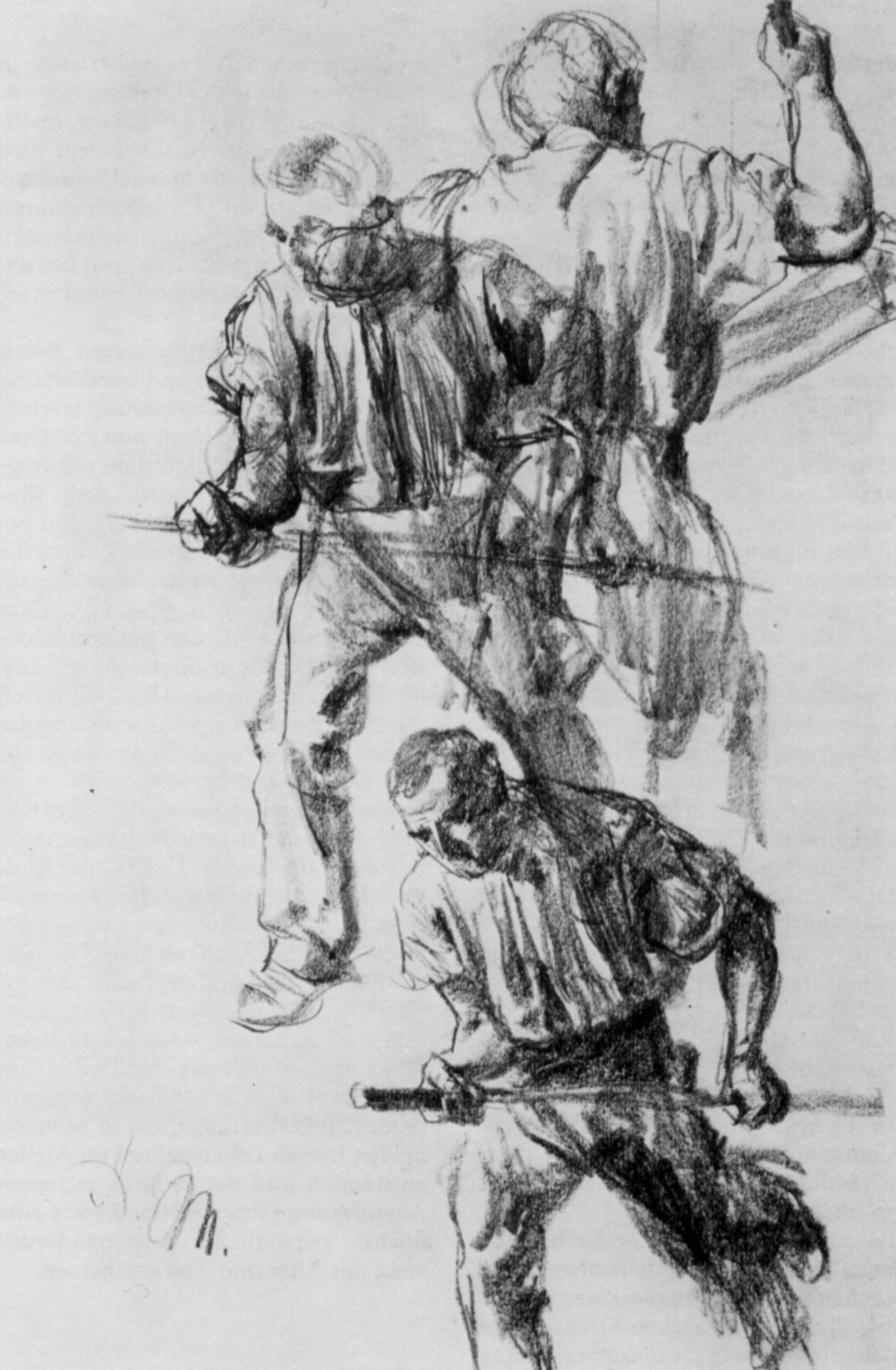
We went to the study-room at the museum for prints and drawings, the Kupferstichkabinett at the Kulturforum at Potsdamer Platz and examined Menzel's prestudies for his painting the Iron rolling mill. Here are some of his drawings of workers that you can find on the website zeno.org
For those studies Menzel mainly used a broad carpenter's pencil which then became his favourite drawing tool. You can see the nearly caligraphic qualities of the rectangular, broad tip on those studies. I will deepen some thoughts on Menzel's drawing equipment in a future post.
Here me and Poul are examining the folder which contains the studies of the mechanical items and devices seen in the final painting. Menzel even noted the size of them in Zoll (the german word for inch). In the painting Menzel arranged them according to the observations of Max Liebermann in a pretty free way. He didn't do a complete preliminary drawing which he then transferred to the canvas but sketched the positions and proportions roughly in and then began to develop figures and surrounding by thoroughly sticking to his pencil studies done on site.
We also had a look at the amazing Menzel folder no. 155, which contains his breathtaking portraits in watercolour and Gouache from the 1850s.
The Kupferstichkabinett holds about 6000 single drawings and 77 sketchbooks by Adolph Menzel. It offers the free service for the public to examine originals in their study room.
Concerning the amount of drawings it is still quite challenging for the very supportive staff to search for folders or single drawings per description.
Here is an offer I make for art enthusiasts: if you are planning on an art trip to Berlin and want to research Menzel's drawings in the Kupferstichkabinett and you know approximately what drawings you are looking for, feel free to contact me at christian.schlierkamp@googlemail.com .
I know a couple of folders and numbers of drawings and may be able to help you.
We then went on to visit the alte Nationalgalerie, which contains a most exquisite collection of 19th century realism and romanticism.
There we examined Menzel's paintings. here's the somewhat not really sharp photo of evidence:
Luckily the museum is on the Google-Art project, where you can come even closer to the paintings than in the museum itself (and at least without releasing the alarm...).
The collection contains among others works by Böcklin, Fritz von Uhde, Max Liebermann, Carl Spitzweg, as well as of the Berlin artist families Begas and Meyerheim.
Here is the breathtaking sculpture "Pan comforting Psyche by Reinhold Begas:
Tomorrow we'll be having a closer look at what Poul sometimes is finding in his attic...
Yesterday we made an expedition exploring Adolph Menzel's work.
We went to the study-room at the museum for prints and drawings, the Kupferstichkabinett at the Kulturforum at Potsdamer Platz and examined Menzel's prestudies for his painting the Iron rolling mill. Here are some of his drawings of workers that you can find on the website zeno.org
For those studies Menzel mainly used a broad carpenter's pencil which then became his favourite drawing tool. You can see the nearly caligraphic qualities of the rectangular, broad tip on those studies. I will deepen some thoughts on Menzel's drawing equipment in a future post.
Here me and Poul are examining the folder which contains the studies of the mechanical items and devices seen in the final painting. Menzel even noted the size of them in Zoll (the german word for inch). In the painting Menzel arranged them according to the observations of Max Liebermann in a pretty free way. He didn't do a complete preliminary drawing which he then transferred to the canvas but sketched the positions and proportions roughly in and then began to develop figures and surrounding by thoroughly sticking to his pencil studies done on site.
We also had a look at the amazing Menzel folder no. 155, which contains his breathtaking portraits in watercolour and Gouache from the 1850s.
The Kupferstichkabinett holds about 6000 single drawings and 77 sketchbooks by Adolph Menzel. It offers the free service for the public to examine originals in their study room.
Concerning the amount of drawings it is still quite challenging for the very supportive staff to search for folders or single drawings per description.
Here is an offer I make for art enthusiasts: if you are planning on an art trip to Berlin and want to research Menzel's drawings in the Kupferstichkabinett and you know approximately what drawings you are looking for, feel free to contact me at christian.schlierkamp@googlemail.com .
I know a couple of folders and numbers of drawings and may be able to help you.
We then went on to visit the alte Nationalgalerie, which contains a most exquisite collection of 19th century realism and romanticism.
There we examined Menzel's paintings. here's the somewhat not really sharp photo of evidence:
Luckily the museum is on the Google-Art project, where you can come even closer to the paintings than in the museum itself (and at least without releasing the alarm...).
The collection contains among others works by Böcklin, Fritz von Uhde, Max Liebermann, Carl Spitzweg, as well as of the Berlin artist families Begas and Meyerheim.
Here is the breathtaking sculpture "Pan comforting Psyche by Reinhold Begas:
Tomorrow we'll be having a closer look at what Poul sometimes is finding in his attic...
Samstag, 19. Juli 2014
Brigitte Schlierkamp
Mom passed away on the 31.st May. This is a sketch I did of her two years ago, when she was already marked by the Parkinson's disease.
This elm tree in her garden was her favourite tree. I sketched it when I visited her for the last time in mid-May this year.
This is the coat of arms of my Mom's family, as we have found it passed down on an old plate.
I slowly find my way back to reality, at least time seems to be much slower now.
Danke, Mama! Für alles!
In Liebe,
Christian
This elm tree in her garden was her favourite tree. I sketched it when I visited her for the last time in mid-May this year.
This is the coat of arms of my Mom's family, as we have found it passed down on an old plate.
I slowly find my way back to reality, at least time seems to be much slower now.
Danke, Mama! Für alles!
In Liebe,
Christian
Mittwoch, 7. Mai 2014
10 minute sketches at the re:publica 14
Yesterday I was comissioned to do quick ten minute sketches at the finance-award of comdirect at the re:publica 14 .
The motto of the conference was "into the wild" thus the drawings feature jungle elements and li'l critters that lurk about.
It was fun and challenging :-)
Here are some samples:
Daniel Saurenz of Feingold research
Financeblogger Michael Schulte, known as Mr. Market
Christiane Krämer, comdirect
The motto of the conference was "into the wild" thus the drawings feature jungle elements and li'l critters that lurk about.
It was fun and challenging :-)
Here are some samples:
Daniel Saurenz of Feingold research
Financeblogger Michael Schulte, known as Mr. Market
Christiane Krämer, comdirect
Sonntag, 4. Mai 2014
general assembly of the german illustrator's organisation IO
a quick sketch I did at the annual general assembly of Germany's illustrator's organisation IO, held in Hamburg yesterday.
Freitag, 2. Mai 2014
Drawing from casts
Drawing after plaster casts is great fun.
It helps a lot to focus on tonal shifts and anatomy.
Nevertheless I find it always astounding to find so much color and reflected light within the shadows and the "white" of the casts.
This cast of a warrior (the so called "fencing Borghese", the original can be seen at the Louvre) at the cast collection of statues from the ancient world in Berlin was lit from a cool window behind and several warm lights in the front.
The collection is a wonderful place to practice drawing, it's open from thursday to sunday (2 to 5 PM).
The entry is free.
Drawing classes that come with 15 or more students can come outside of the regular opening hours for a fee of 2 €'s per student.
It helps a lot to focus on tonal shifts and anatomy.
Nevertheless I find it always astounding to find so much color and reflected light within the shadows and the "white" of the casts.
This cast of a warrior (the so called "fencing Borghese", the original can be seen at the Louvre) at the cast collection of statues from the ancient world in Berlin was lit from a cool window behind and several warm lights in the front.
The collection is a wonderful place to practice drawing, it's open from thursday to sunday (2 to 5 PM).
The entry is free.
Drawing classes that come with 15 or more students can come outside of the regular opening hours for a fee of 2 €'s per student.
Mittwoch, 30. April 2014
Locomotive breath
Recently I went to the Springfestival of the Dampflokfreunde Berlin e.V. (steam train friends Berlin) and took a trip back in time.
I did two coloured sketches of these old engines and learned a bit about their past:
the52 series was originally developped during WWII by the army as a heavy war machine. After the abatement of the Nazi regime it was still in use and throughlived slight modifications. In the former GDR it was still in use till the late 1960's.
The small Diesel light rail tractor Kö 5734 was built in 1942/43 and was sorted out as recently as 1994 (!).
Here you can see me draw the 52-engine.
It's possible to book extra tours with the 52 series in the outskirts of Berlin.
An overview of the tours can be viewed here.
Thanks to Johannes Neu for the photographs.
![]() |
| photo by Joachim Neu |
I did two coloured sketches of these old engines and learned a bit about their past:
the52 series was originally developped during WWII by the army as a heavy war machine. After the abatement of the Nazi regime it was still in use and throughlived slight modifications. In the former GDR it was still in use till the late 1960's.
The small Diesel light rail tractor Kö 5734 was built in 1942/43 and was sorted out as recently as 1994 (!).
Here you can see me draw the 52-engine.
| photography by Joachim Neu |
It's possible to book extra tours with the 52 series in the outskirts of Berlin.
An overview of the tours can be viewed here.
Thanks to Johannes Neu for the photographs.
Samstag, 26. April 2014
sketching Dinos in the wild...
If it comes to sketching animals I rather prefer to sketch from life than anything else.
If you have the possibility to draw animals in their natural surrounding you should always give it a shot.
Luckily we do have a couple of dinosaurs in the outskirts of Berlin, it's not really hard to find them.
Although I really love the silhouettes of ceratopsians they are a quite delicate subject and can become easily aggressive, especially in the springtime when they are having their young...
giant crocodiles are better to be sketched from a distance...
And I told the kids not to get too close...
Next to that we learned that as a matter of fact Spinosaurus wasn't as dangerous as he is generally depicted...
Experts assume that there is a correlation between vegetarianism in spinosaurs and the growth...errmm...of trees.
Two years ago Spino was still carnivorous...;-P
Today we had a blast at the Tier- und Freizeitpark Germendorf.
If you have the possibility to draw animals in their natural surrounding you should always give it a shot.
Luckily we do have a couple of dinosaurs in the outskirts of Berlin, it's not really hard to find them.
Although I really love the silhouettes of ceratopsians they are a quite delicate subject and can become easily aggressive, especially in the springtime when they are having their young...
giant crocodiles are better to be sketched from a distance...
And I told the kids not to get too close...
Next to that we learned that as a matter of fact Spinosaurus wasn't as dangerous as he is generally depicted...
Experts assume that there is a correlation between vegetarianism in spinosaurs and the growth...errmm...of trees.
Two years ago Spino was still carnivorous...;-P
Today we had a blast at the Tier- und Freizeitpark Germendorf.
Freitag, 25. April 2014
The laws of physics...
...ye cannot change....
Yesterday I finished a comission late at night (or better: early in the morning...it's that shocking moment when the birds start to sing outside and you realize what time it is already.)
Happily I turned around to clean the brushes and by doing so unintentionally knocked over the water glas...the least thing I needed. *Arrgh!*
But instead of spilling the water all over the room or to break the glass it just fell perfectly upside down, with just a few drops spilled around it.
I never saw something like this:
The water remained allmost completely inside the glass.
Today I left it like that; I'm just too curious to see how long the glass can hold the water this way...
Yesterday I finished a comission late at night (or better: early in the morning...it's that shocking moment when the birds start to sing outside and you realize what time it is already.)
Happily I turned around to clean the brushes and by doing so unintentionally knocked over the water glas...the least thing I needed. *Arrgh!*
But instead of spilling the water all over the room or to break the glass it just fell perfectly upside down, with just a few drops spilled around it.
I never saw something like this:
Today I left it like that; I'm just too curious to see how long the glass can hold the water this way...
Sonntag, 6. April 2014
anatomica draconis - part I
I guess this is going to become a series of blog posts since hence I feel not capable to sumarize a vast theme like this in one post.
One of my art students, Miriam Häusler, approached me with a most crucial question within Fantasy-Art and I am ever so happy and thankful about that question because it helps me to thoroughly think over a theme that seems to have become common sense within Fantasy and that is why, in my point of view, it is necessairy to have a closer and conscious look at it over and over again.
The question was of how to approach the anatomy of dragons.
I postponed our lesson and arranged an expedition to the natural history museum one week later to set out for our queste for Draco.
There are several reasons why I chose the natural history museum as a starting point to approach dragons:
1) the impression of size.
Looking at pictures of reptiles, birds, other paintings of dragons etc might be helpful to get a first idea but to me only if one is confronted with the true sensual sensation of the size of existing creatures we get a better notion of what inches, metres or cubits look like in "real bones".
2) anatomical diversity and possibilities within nature
If you look at the skeletons of real creatures it helps you a lot to gradually develop an eye for specializations of anatomical features and starting from there to begin to develop your own ideas of anatomical possibilities for a creature, we see in front of our inner eye.
Here are some examples:
3) if we limit ourselves to the two points mentioned above in my point of view we reduce ourselves rather by practicing "Science Fiction" and will not touch the mythological/archetypical nature of the dragon sufficiently.
the mythological aspect of fossilised bones
I am always in awe when I approach the real skeletons of extinct creatures, the fossilised bones which represent the immense span of time which symbolically resembles to me as well the immortality of the dragon, emblem of the forces of nature in their unpredcitability.
To me they are in fact like sculptures in their sheer beauty and the purest inspiration.
recommended readings:
John Howe - Forging Dragons *
John Howe - the Fantasy Art Workshop*
Daniel Falconer - Smaug: Unleashing the dragon
Joseph Reichholf - Einhorn, Phönix, Drache
* Forging Dragons and the Fantasy Art Workshop in German language
One of my art students, Miriam Häusler, approached me with a most crucial question within Fantasy-Art and I am ever so happy and thankful about that question because it helps me to thoroughly think over a theme that seems to have become common sense within Fantasy and that is why, in my point of view, it is necessairy to have a closer and conscious look at it over and over again.
The question was of how to approach the anatomy of dragons.
I postponed our lesson and arranged an expedition to the natural history museum one week later to set out for our queste for Draco.
There are several reasons why I chose the natural history museum as a starting point to approach dragons:
1) the impression of size.
![]() |
Looking at pictures of reptiles, birds, other paintings of dragons etc might be helpful to get a first idea but to me only if one is confronted with the true sensual sensation of the size of existing creatures we get a better notion of what inches, metres or cubits look like in "real bones".
2) anatomical diversity and possibilities within nature
If you look at the skeletons of real creatures it helps you a lot to gradually develop an eye for specializations of anatomical features and starting from there to begin to develop your own ideas of anatomical possibilities for a creature, we see in front of our inner eye.
Here are some examples:
![]() |
| Diplodocus, who's long neck and tail equal in it's functionality the construction of a modern suspension bridge. |
![]() |
| Allosaurus' impressive skull, the chambers in the skull helped to keep it light weighted |
![]() |
| skeleton of a sea eagle in comparison with Allosaurus' arms and claws |
3) if we limit ourselves to the two points mentioned above in my point of view we reduce ourselves rather by practicing "Science Fiction" and will not touch the mythological/archetypical nature of the dragon sufficiently.
the mythological aspect of fossilised bones
I am always in awe when I approach the real skeletons of extinct creatures, the fossilised bones which represent the immense span of time which symbolically resembles to me as well the immortality of the dragon, emblem of the forces of nature in their unpredcitability.
To me they are in fact like sculptures in their sheer beauty and the purest inspiration.
recommended readings:
John Howe - Forging Dragons *
John Howe - the Fantasy Art Workshop*
Daniel Falconer - Smaug: Unleashing the dragon
Joseph Reichholf - Einhorn, Phönix, Drache
* Forging Dragons and the Fantasy Art Workshop in German language
Sonntag, 23. März 2014
Renée Sintenis
The Special exhibition on the life and work of Berlin based artist Renée Sintenis comemorating her 125th anniversairy can still be seen at the Georg Kolbe Museum till the end of March.
The english Wikipedia article on Sintenis unfortunately is a stub, so here's the text from the Kolbe Museum:
"Renée Sintenis (1888–1965) was one of the major sculptors of the first half of the 20th century. Her best-known work is the Berlinale Bear, the highly symbolic icon awarded annually at the International Film Festival. The Georg Kolbe Museum is dedicating a comprehensive retrospective exhibition encompassing over 100 sculptures to the Berlin artist on the occasion of her 125th birthday: animal figures cast in bronze and silver, striking depictions of athletes and expressive portraits, some of which portray such close friends as the writer and cabaret artist Joachim Ringelnatz who composed a series of touching tongue-in-cheek poems for Sintenis. A number of historical photographs additionally convey a vivid picture of the emancipated protagonist from Berlin’s pre-war art world who was the epitome of the frequently invoked feminist ideal of the “New Woman.” The exhibited works lent largely by the Knauf Collection, Berlin, are supplemented by pieces from the holdings of the Neue Nationalgalerie and the Georg Kolbe Museum.
The exhibition is accompanied by a comprehensive scholarly catalogue presenting the sculptural work of Renée Sintenis."
I was visiting the exhibition together with the local urban sketchers, which was a fun experience.
The Kolbe museum with it's small park, filled with Kolbe's sculptures is truly an enchanting place with a small Café in his former residential building and the museum in his atelier.
The Sintenis exhibition does not only showcase the equisite animal sculptures of Sintenis (including the "Berlinale Bear" for which she presumably is best known for internationally) but as well her selfportraits and the portraits of artist colleagues as a lot of photographies on her and her life.
That's the famous bear, but there's much, much more to be seen.
Especially her miniatures of sportsmen, kids and horses are of an incredible dynamic:
Here is a great article on her in the ART-magazine (in German language)
This picture shows Sintenis together with Aristide Maillol, Albert Einstein and Max Liebermann in1930:
The english Wikipedia article on Sintenis unfortunately is a stub, so here's the text from the Kolbe Museum:
"Renée Sintenis (1888–1965) was one of the major sculptors of the first half of the 20th century. Her best-known work is the Berlinale Bear, the highly symbolic icon awarded annually at the International Film Festival. The Georg Kolbe Museum is dedicating a comprehensive retrospective exhibition encompassing over 100 sculptures to the Berlin artist on the occasion of her 125th birthday: animal figures cast in bronze and silver, striking depictions of athletes and expressive portraits, some of which portray such close friends as the writer and cabaret artist Joachim Ringelnatz who composed a series of touching tongue-in-cheek poems for Sintenis. A number of historical photographs additionally convey a vivid picture of the emancipated protagonist from Berlin’s pre-war art world who was the epitome of the frequently invoked feminist ideal of the “New Woman.” The exhibited works lent largely by the Knauf Collection, Berlin, are supplemented by pieces from the holdings of the Neue Nationalgalerie and the Georg Kolbe Museum.
The exhibition is accompanied by a comprehensive scholarly catalogue presenting the sculptural work of Renée Sintenis."
I was visiting the exhibition together with the local urban sketchers, which was a fun experience.
The Kolbe museum with it's small park, filled with Kolbe's sculptures is truly an enchanting place with a small Café in his former residential building and the museum in his atelier.
The Sintenis exhibition does not only showcase the equisite animal sculptures of Sintenis (including the "Berlinale Bear" for which she presumably is best known for internationally) but as well her selfportraits and the portraits of artist colleagues as a lot of photographies on her and her life.
That's the famous bear, but there's much, much more to be seen.
Especially her miniatures of sportsmen, kids and horses are of an incredible dynamic:
Here is a great article on her in the ART-magazine (in German language)
This picture shows Sintenis together with Aristide Maillol, Albert Einstein and Max Liebermann in1930:
Abonnieren
Posts (Atom)