Mittwoch, 5. Juni 2013
U1
I had a great day with the team of the strategy-agency diffferent. I used a small break to sketch the beautiful view. From their rooftop you can see the tracks of line U1 leading over schlesische Straße.
Sonntag, 2. Juni 2013
Momo, Michael Ende and the money-go-round
This year the 40th anniversary of Michael Ende's children book classic "Momo" is being celebrated.
Michael Ende dealt for a long time with philosophical questions about the monetary system especially with Rudolf Steiner' s and Silvio Gesell's thought system of social threefolding which is based on ideas by Wilhelm von Humboldt, summarized in his 1792 essay "über die Grenzen der Wirksamkeit des Staates" ("the Sphere and Duties of Government (the limits of State Action)").
Ende discussed those ideas already at the beginning of the 1980's in interviews with e.G. the artist Joseph Beuys ("Kunst und Politik") and politician Erhard Eppler ("Phantasie, Kultur, Politik").
In an elaborate documentation of Sat1.Bayern the contemporary relevance of "Momo" is now highlighted, among others with proof of a letter conversation between macro economist Werner Onken and Ende.
Onken wrote an essay interpreting "Momo" in an economical context. He sent his essay to Michael Ende asking wether he was right with his analysis and received the following answer:
You can find the whole German langauge essay of Werner Onken here
"Geld und Magie" ("money and magic") by Hans Chr. Binswanger: an economical interpretation of Goethe's "Faust"
Michael Ende dealt for a long time with philosophical questions about the monetary system especially with Rudolf Steiner' s and Silvio Gesell's thought system of social threefolding which is based on ideas by Wilhelm von Humboldt, summarized in his 1792 essay "über die Grenzen der Wirksamkeit des Staates" ("the Sphere and Duties of Government (the limits of State Action)").
Ende discussed those ideas already at the beginning of the 1980's in interviews with e.G. the artist Joseph Beuys ("Kunst und Politik") and politician Erhard Eppler ("Phantasie, Kultur, Politik").
In an elaborate documentation of Sat1.Bayern the contemporary relevance of "Momo" is now highlighted, among others with proof of a letter conversation between macro economist Werner Onken and Ende.
Onken wrote an essay interpreting "Momo" in an economical context. He sent his essay to Michael Ende asking wether he was right with his analysis and received the following answer:
"Dear Mr Onken,
Thank you very much for your letter and
for sending me your essay! I am very lucky that you understood my book so
well, especially concerning it's esoterical and economical
background.
By the way, you are the first one to realize that the idea of aging
money dwells in the background of my book MOMO. During the last years I
had been deeply involved with precisely these thoughts of Steiner and
Gesell since I have come to the conviction, that the whole of our
cultural question cannot be solved without solving the money problem at
the same time or even before.
May I call your attention at this
opportunity to the book „Geld und Magie*“ by professor
Binswanger, published by Edition Weitbrecht. I believe it could be of
great interest to you.
Once again my cordially thanks.
With kind regards
Michael Ende"
As Ende's longtime friend and publisher Roman Hocke states in the documentary: If Michael Ende would hear about the actual discussion and understanding of Momo today he would presumably say:
"Eventually!"
Link to the German language documentary by Sat1.Bayern.
The drawn animations in the film were done by Berlin based illustration/animation artist Danae Diasz
"Geld und Magie" ("money and magic") by Hans Chr. Binswanger: an economical interpretation of Goethe's "Faust"
Donnerstag, 30. Mai 2013
Adolph Menzel on Franz von Lenbach
Adolph Menzel's judgement on art was harsh; the bar he'd raised for himself and his fellow artists was incredibly high.
Some of his hard judgement on the work of his contemporairies is passed on.
According to Joachim von Küremberg his judgement on Franz von Lenbach was as follows:
"Among many irrelevant things there are some rare cliffs that are standing out of the floods! - The main mishap with Lenbach is that he cannot draw, one only has to look at his laces, decoration and uniforms. They are painted completely nonchalant and really lousy! (...) This bavarian Franzl is painting on every tuesday- and friday afternoon a picture of Bismarck after an enlarged photography which he is tracing, then he is painting in the eyes, at the most he's merely sketching in the face and mumbles the rest altogether in a brown sauce; for doing so this barbarian receives thirtythousand marks."
(quoted from Gisold Lammel, "Anekdoten über die kleine Exzellenz", Berlin 1989)
Franz von Lenbach, Bismarck with hat, 1880
In this context I find it plausible and worth mentioning that Menzel is the only painter for whom David Hockney could surely proove in his book "Secret Knowledge: Rediscovering the lost techniques of the Old Masters" that he didn't use photographies or the help of projectors for his drawings.
Wikipedia article on Adolph Menzel
Wikipedia article on Franz von Lenbach
David Hockney's "Secret Knowledge: Rediscovering the lost techniques of the Old Masters" on Amazon
Dienstag, 28. Mai 2013
official partners
I'm thrilled to anounce that I am the official partner of Heel publishing, the German publisher of John Howe's Fantasy Art workshop to give art instruction lessons based on his books.
More infos to follow soon on
http://www.christianschlierkamp.de/teachings_christian_schlierkamp_de.html
More infos to follow soon on
http://www.christianschlierkamp.de/teachings_christian_schlierkamp_de.html
Montag, 27. Mai 2013
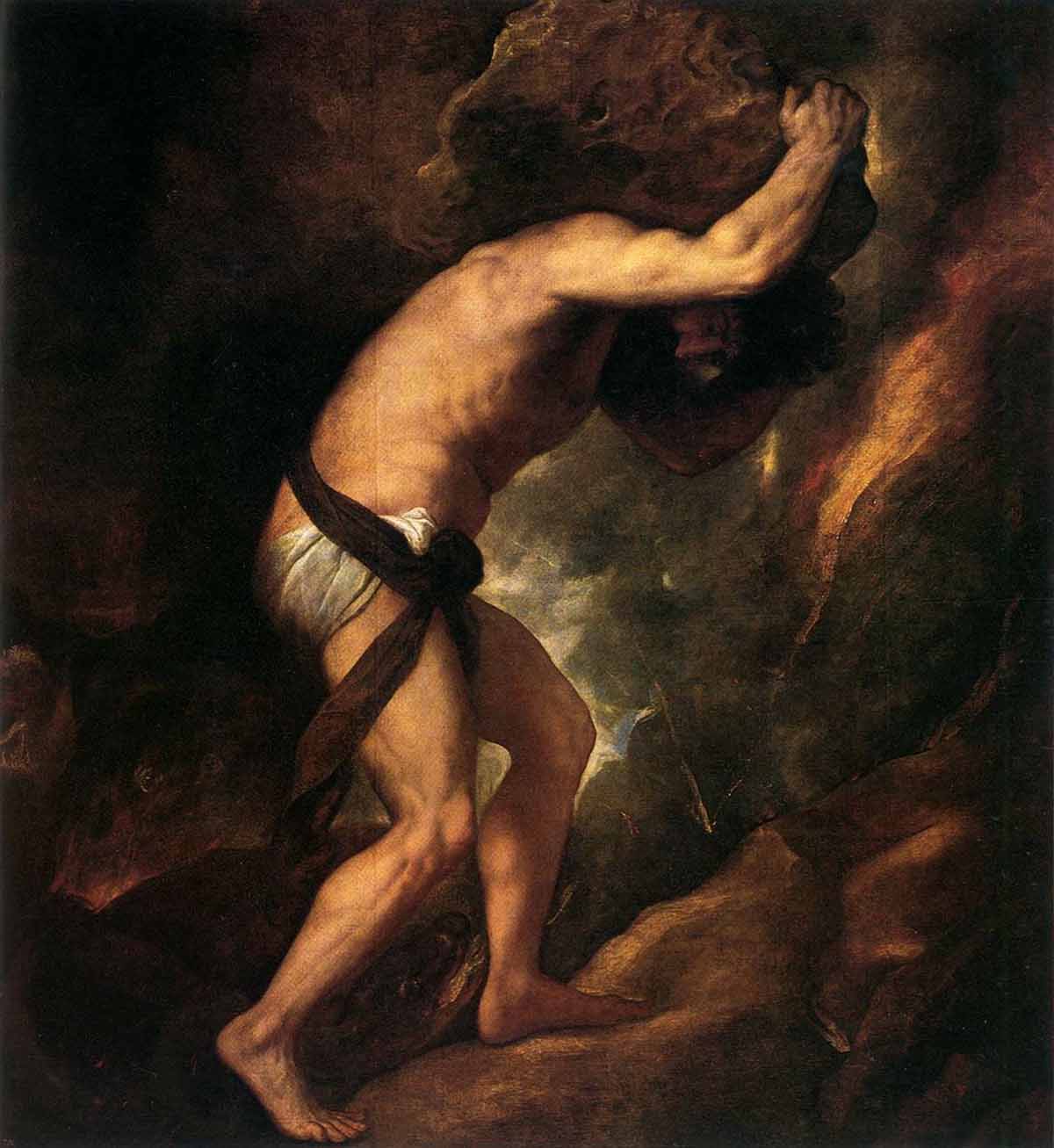
Sisyphus
Sisyphus by Titian, 1548/49
"When Sisyphus comes to understand that it's the process that matters more than the result, he's not doomed anymore."
Michael Ende, "the archaeology of darkness - interviews on art and the work of the painter Edgar Ende", pg 29
"Wenn Sisyphus begreift, daß die Tätigkeit wichtiger ist als das Ergebnis, dann ist er nicht mehr verdammt."
Michael Ende, "Die Archäologie der Dunkelheit - Gespräche über Kunst und das Werk des Malers Edgar Ende", S. 29
Freitag, 19. April 2013
Choreology
Raimar Heber, head of the dpa-infografik graphic design department organises a monthly get together of Graphic Designers, Illustrators and other visually communicating folks in Berlin, choosing from a broad range of topics that mainly focus on different approaches of visual communication.
Yesterday we were introduced to Tatjana Thierbach, who is one of the few professional practitioners of the Benesh Movement Notation system in Germany.
Coming from the classical ballett movement notation is used in many diferent instances where the communication of complex movements with others or to pass choreographies on to later generations is used.
Younger than other notation systems the first known attempts to write down movements date back to the court of Louis XIV, le Roi Soleil.
It is mainly used to help the choreographer in classical ballet. Other fields are as well in filmmaking and also as a helpful tool for physiotherapists, where the langauge developped it's very own complex forms.
Tatjana studied at John Cranko's Ballet school in Stuttgart where she met Uwe Scholz, who was very much influenced by John Cranko.
Cranko relied very much on the Benesh Notation System, which inflamed Scholz to use it for his choreographies as well. Tatjana decided to study the system and became a close assistant to Scholz and after his untimely passing away an important preserver of his cultural heritage.
The Notation system itself equals the classical notation system with five staves and barlines.
You can find free introductory videos to the system online on dancewrite.com.
We gathered at the lovely Café Blume, close to Volkspark Hasenheide in Neukölln.
The Café is run by Tatjana and her partner, who is touring with Andrew Lloyd Webber's Cats, based on the idea to fill a gap they faced with their kids and to develop a family friendly Café with a playing area for kids close to the park.
Lovely place, wonderful people and a great evening.
Thanks a lot, Tatjana and Raimar for arranging this truly enchanting event!
Yesterday we were introduced to Tatjana Thierbach, who is one of the few professional practitioners of the Benesh Movement Notation system in Germany.
Coming from the classical ballett movement notation is used in many diferent instances where the communication of complex movements with others or to pass choreographies on to later generations is used.
Younger than other notation systems the first known attempts to write down movements date back to the court of Louis XIV, le Roi Soleil.
It is mainly used to help the choreographer in classical ballet. Other fields are as well in filmmaking and also as a helpful tool for physiotherapists, where the langauge developped it's very own complex forms.
Tatjana studied at John Cranko's Ballet school in Stuttgart where she met Uwe Scholz, who was very much influenced by John Cranko.
Cranko relied very much on the Benesh Notation System, which inflamed Scholz to use it for his choreographies as well. Tatjana decided to study the system and became a close assistant to Scholz and after his untimely passing away an important preserver of his cultural heritage.
The Notation system itself equals the classical notation system with five staves and barlines.
You can find free introductory videos to the system online on dancewrite.com.
We gathered at the lovely Café Blume, close to Volkspark Hasenheide in Neukölln.
The Café is run by Tatjana and her partner, who is touring with Andrew Lloyd Webber's Cats, based on the idea to fill a gap they faced with their kids and to develop a family friendly Café with a playing area for kids close to the park.
Lovely place, wonderful people and a great evening.
Thanks a lot, Tatjana and Raimar for arranging this truly enchanting event!
Dienstag, 9. April 2013
An interview with Rien Poortvliet
A couple of days ago my friend Christoph Heuer sent me a link to this video featuring an interview with the famous dutch animal and landscape painter
Rien Poortvliet.
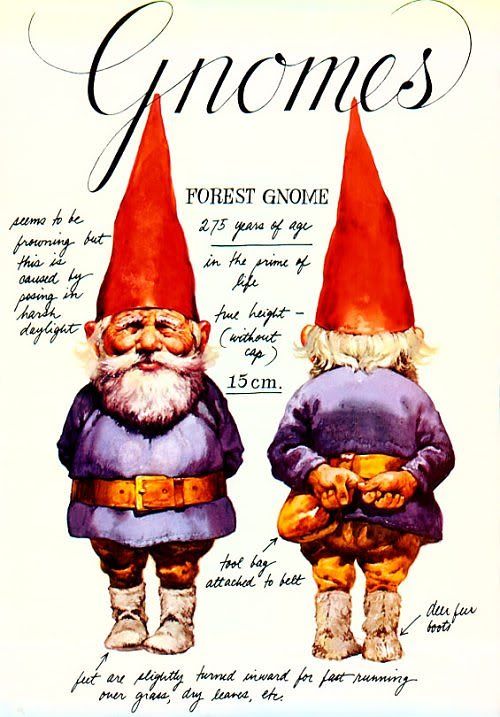
Most known for his scientific take on "Gnomes" his work encompasses as well books on the dutch history, hunt, horses and wildlife.
Most of his books have the characteristics of an explorers diary, with a sketchy loose approach.
There is an elaborate post on Poortvliet and his work featuring the video on Armand Carbrera's blog "Art and influence"
Rien Poortvliet.
Most known for his scientific take on "Gnomes" his work encompasses as well books on the dutch history, hunt, horses and wildlife.
Most of his books have the characteristics of an explorers diary, with a sketchy loose approach.
There is an elaborate post on Poortvliet and his work featuring the video on Armand Carbrera's blog "Art and influence"
Montag, 8. April 2013
Warriors and Warlords
Today I received my copy of Angus McBride's "Warriors and Warlords"
Which completely blew me away.
It does not only feature McBride's outstanding illustrations for Osprey publishing but the foreword comes also with excerpts from elaborate interviews that Martin Windrow conducted with him.
There are a couple of great insights to his painting technique and his process (the main body of his work is done in gouache) as well as on the business side of the life of an illustrator.
I can warmly recommend to go for that book!
The interview closes with some words of wisdom for the aspiring artist, which I found very helpful for me:
"let's just say: there is no substitute for lifedrawing classes. They may be 'detrimental to the free flow of inspiration...' - but unless students are actually taught how to draw, God knows how the poor little devils ever expect to make a living. (...)
You have to learn thoroughly the basic mechanics of reproduction and publishing. You have to learn how to meet a deadline. And perhaps, most of all, you have to be a kind of frustrated teacher, always itching to pass things on, to share them and make them plainer - because in the long run, that's what illustration is for.
In the end I can't say much more than, find a subject that genuinely excites you, illustrate it as well as you can, and show your work to every agent and publisher you can track down. And, of course, you have to accept that the learning process is going to last for the rest of your life."
Angus McBride
Which completely blew me away.
It does not only feature McBride's outstanding illustrations for Osprey publishing but the foreword comes also with excerpts from elaborate interviews that Martin Windrow conducted with him.
There are a couple of great insights to his painting technique and his process (the main body of his work is done in gouache) as well as on the business side of the life of an illustrator.
I can warmly recommend to go for that book!
The interview closes with some words of wisdom for the aspiring artist, which I found very helpful for me:
"let's just say: there is no substitute for lifedrawing classes. They may be 'detrimental to the free flow of inspiration...' - but unless students are actually taught how to draw, God knows how the poor little devils ever expect to make a living. (...)
You have to learn thoroughly the basic mechanics of reproduction and publishing. You have to learn how to meet a deadline. And perhaps, most of all, you have to be a kind of frustrated teacher, always itching to pass things on, to share them and make them plainer - because in the long run, that's what illustration is for.
In the end I can't say much more than, find a subject that genuinely excites you, illustrate it as well as you can, and show your work to every agent and publisher you can track down. And, of course, you have to accept that the learning process is going to last for the rest of your life."
Angus McBride
Sonntag, 7. April 2013
cheapest way to get a glass palette
If you're working in oils you will want to have a decent palette.
I was thinking of how to build a glass palette (which is easy to clean, plus you can put a neutral gray background behind it; which is helpful to see the true colours without them being altered by the wooden colour or white of a handheld palette) for my taboret until I found this extremely helpfull website about the selfmade classical atelier at home by illustrator Björn Gschwendtner .
The solution is facepalmingly simple, logical and ingenious:
buy a simple frame for pictures, put a gray cardboard or whatever colour you work with to tone your panels or canvasses as a background and there you go:
:-)
I was thinking of how to build a glass palette (which is easy to clean, plus you can put a neutral gray background behind it; which is helpful to see the true colours without them being altered by the wooden colour or white of a handheld palette) for my taboret until I found this extremely helpfull website about the selfmade classical atelier at home by illustrator Björn Gschwendtner .
The solution is facepalmingly simple, logical and ingenious:
buy a simple frame for pictures, put a gray cardboard or whatever colour you work with to tone your panels or canvasses as a background and there you go:
:-)
Samstag, 6. April 2013
Raven
The first kickstarter campaign I ever supported was Paula Cole's album project "Raven".
Yesterday I downloaded the album and I love it through and through.
It was as well Paula Cole's birthday.
(Happy belated birthday!!)
The sound and the songs of the album are brilliant, she's weaving her songs and themes with wonderfully earthy colours.
Here's a watercolour that I did last year, wondering what a cover for the album could look like:
You can listen to some excerpts of the album on Paula Cole's Webside.
Yesterday I downloaded the album and I love it through and through.
It was as well Paula Cole's birthday.
(Happy belated birthday!!)
The sound and the songs of the album are brilliant, she's weaving her songs and themes with wonderfully earthy colours.
Here's a watercolour that I did last year, wondering what a cover for the album could look like:
You can listen to some excerpts of the album on Paula Cole's Webside.
Freitag, 5. April 2013
Dinosaur Art Contest
Just in Case you've missed this:
There's still a dinosaur art contest going on at the Stan Winston School of Character Arts!
*G!*
"the Pianosaurus", Christian Schlierkamp, 2012
There's still a dinosaur art contest going on at the Stan Winston School of Character Arts!
*G!*
"the Pianosaurus", Christian Schlierkamp, 2012
Donnerstag, 4. April 2013
Collecting colours
If you're riding on a train or don't have enough time to do an elaborate study of a scene, there's still a fun thing one can do: fetching the colours of your view in small patches.
Over the time you can thus gather a whole library of colour mixtures that you can later use in final works.
This collection of patches came from my view out of the train, while driving back to Berlin.
The scenery was pretty clear with a bit of dusk above the horizon, open fields were changing with small patches of forests.
I found that hint in Felix Scheinberger's "Wasserfarben für Gestalter" ("water colours for designers")
Over the time you can thus gather a whole library of colour mixtures that you can later use in final works.
This collection of patches came from my view out of the train, while driving back to Berlin.
The scenery was pretty clear with a bit of dusk above the horizon, open fields were changing with small patches of forests.
I found that hint in Felix Scheinberger's "Wasserfarben für Gestalter" ("water colours for designers")
Mittwoch, 3. April 2013
sketchbook pages from Cologne
Back from my visit in Cologne, where I met with long not seen friends and family.
We had a great time.
Here are some of the sketchbookpages from our visit:
We had a great time.
Here are some of the sketchbookpages from our visit:
Sonntag, 24. März 2013
Kai is reading
My son Kai learns how to read.
I'm always in awe when I see my kids manage to learn a new task and that everything that we are able to do today and oftimes are tending to take for granted was difficult and only through diligence to achieve once.
To me the attitude of a learning child, open, curious and persistend in it's continuous striving is the most inspiring one.
I'm always in awe when I see my kids manage to learn a new task and that everything that we are able to do today and oftimes are tending to take for granted was difficult and only through diligence to achieve once.
To me the attitude of a learning child, open, curious and persistend in it's continuous striving is the most inspiring one.
Samstag, 23. März 2013
the Making of "Mysteries of Miskatonic University", part 2
Building a tableau
In today's post I want to show you a bit more of the process of the painting "Mysteries of Miskatonic University".
In the first part I told a bit about materials and inspiration I gathered, out of time and organisational reasons most of them are photoreferences.
In my point of view photoreferences are an absolut legitimate support for your final painting but they do come with certain challenges.
Firstly they are already translation from the threedimonsional space into a twodimensional picture which limits the information we can gather from them.
And secondly most photographies do as well limit the value range by clipping in the highlights and shadows.
What I did to deal with those challenges was firstly to make a little tableau, a small modelkit of my compositional sketch.
This practice has already been in use mainly by painters of historical or mythological scenes in the 19th century:
I start out to build a model of my main character:
Errmm...wrong picture:
I built a rough model out of mash wire and tecclay and lit it:
Here is another picture from a later stage where I used additional reference material for the gun. In the background you can see that I also used a small globe that has a small bulb inside to get a notion of how the bluish moonlight falls onto the main character's shoulder:
I then did a black and white drawing on my board and an underlying tonal painting (in acrylics, I used raw umber on this one).
After that I painted a smaller sized poster study, a rough version of the painting, to explore color range and tones I want to use in the final piece:
Here you can also see my set up while I'm working. On the right hand side I have my computer, I usually load all my photoreference into one Photoshop file on different layers. Far left is a small taboret with brushes, water reservoir (on this painting I used water soluble oil colors) and next to that the tableau.
During the process of painting I didn't do any photographs (sorry, it consumed my whole attention :-)): I worked from area to area, starting out with the face:
This is the final piece:
For the figure of Siobhain McCorkindale I also used the principles of shapewelding and as well the windmill principle to help her better blend into the picture.
Main painting references for this painting were
James Gurney's Imaginative realism
and as well the tutorial videos by Scott Waddell, especially "the Art of painting" and the extended version of Webisode 7
I hope you enjoyed that little trip through this painting process and could draw something for you from it.
Tomorrow I'll be off to Cologne for a week and I'm looking forward to be sharing some impressions from there with you.
Freitag, 22. März 2013
buy one, buy two, give it to strangers...
we interrupt our Making of Feature for a brief happy anouncement:
The textbooks for my advanced artstudents arrived:
After a basic drawing course I usually start out to work on pictures with a more complex content aligning to John Howe's Fantasy Art Workshop (German: Handbuch der Fantasy Kunst).
If you follow the posts by John Howe on social networks and on his webside you will know that he sometimes anounces publications with a pretty subtle kind of promotion ;-) :
"Buy one, buy two, give it to your friends and strangers you meet on the streets."
My art workshops give me the good opportunity to broad grinningly do so.
("always at your service!")
The German version comes as a rugged Hardcover, perfect for a often to be used studio reference and is published by Heel Verlag in Königswinter.
The textbooks for my advanced artstudents arrived:
After a basic drawing course I usually start out to work on pictures with a more complex content aligning to John Howe's Fantasy Art Workshop (German: Handbuch der Fantasy Kunst).
If you follow the posts by John Howe on social networks and on his webside you will know that he sometimes anounces publications with a pretty subtle kind of promotion ;-) :
"Buy one, buy two, give it to your friends and strangers you meet on the streets."
My art workshops give me the good opportunity to broad grinningly do so.
("always at your service!")
The German version comes as a rugged Hardcover, perfect for a often to be used studio reference and is published by Heel Verlag in Königswinter.
Donnerstag, 21. März 2013
the Making of "Mysteries of Miskatonic University", part 1
Choosing a theme and collecting references
To work harder on my portfolio and find clients and publishers that suit the way I illustrate I decided to contact a professional advisor for illustrators. Through the German illustrator's organisation IO I was introduced to Mrs Karin Gruß, who has been working with illustrator's in the editorial offices of many of the important german publishers for over twenty years.We thoroughly went through my portfolio and decided to as well add a few a more darker pictures.
A good oportunity to play around with two themes that I wanted to explore a bit more for a longer time:
the weird fiction of H.P. Lovecraft and a bit of Steampunk.
I started out with some sketching and decided to go for a composition like this:
In the Natural historical museum in Berlin there's one big room with old compounds in glasses; floating and warped in their conserving fluid I find them most peculiar and strange and being locked in with them in a room at night seemed to be one of the most unpleasant things I could think of.
Sending our protagonist at nighttimes through a creepy old univeristy, filled with mysterious books and Grimoires and as well some of those weird species invented by Lovecraft preparated in those jugs seemed to be a fitting setting to me.
Here are some of the reference pictures I took at the Natural Historical Museum in Berlin:
*Yikes!*
Concerning the protagonist for the pictures (it's going to be a small series) I wanted to go for a female protagonist. A cunning investigator of the supernatural who is capable of dealing with fierce, extraterrestrial, ancient species.
I gave her the name of an old character a friend of mine used in the "Call of Cthulhu" roleplaying game:
Siobhain McCorkindale.
Two good Friends of mine, singer and actress Mirjam Zipf and her husband photographer Philipp Schläper liked the project, joined the fun and helped me with quickly improvised costumes with diver-goggles and an old coat:
My brother Martin got me a reference shot of himself for the old and worn out leather jacket:
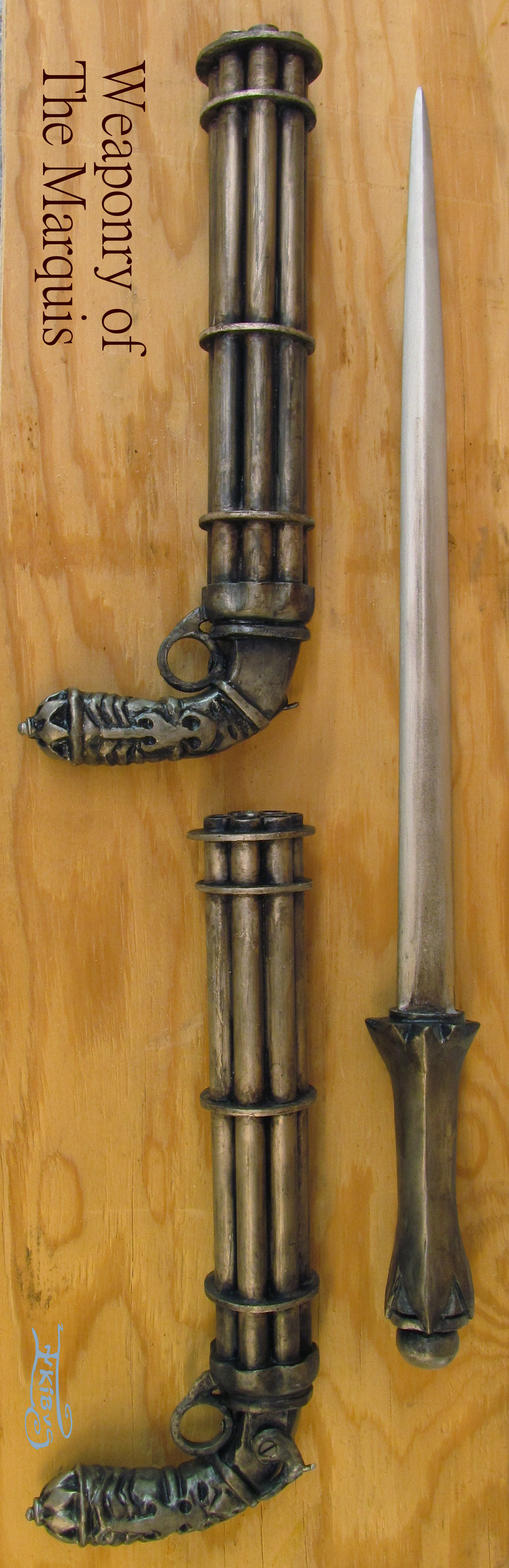
Another dear friend, Alanna Schmitt a.k.a. Inkibus who is making props and costumes helped me tremendously with the costume research and was so generous to let me use one of her props as a basis for the weapon of Siobhain McCorkindale:
A big and cordially thank you for all of your support!!!
Those were the main references. During the process of painting I added a few more, like an old sheepfur for the collar of the jacket etc.
Tomorrow I show you how I built and lit a small reference modell and the process of the painting.
Abonnieren
Posts (Atom)