Freitag, 25. April 2014

The laws of physics...

...ye cannot change....


Yesterday I finished a comission late at night (or better: early in the morning...it's that shocking moment when the birds start to sing outside and you realize what time it is already.)

Happily I turned around to clean the brushes and by doing so unintentionally knocked over the water glas...the least thing I needed. *Arrgh!*

But instead of spilling the water all over the room or to break the glass it just fell perfectly upside down, with just a few drops spilled around it.
I never saw something like this:

The water remained allmost completely inside the glass.

Today I left it like that; I'm just too curious to see how long the glass can hold the water this way...


Sonntag, 6. April 2014

anatomica draconis - part I

I guess this is going to become a series of blog posts since hence I feel not capable to sumarize a vast theme like this in one post.

One of my art students, Miriam Häusler, approached me with a most crucial question within Fantasy-Art and I am ever so happy and thankful about that question because it helps me to thoroughly think over a theme that seems to have become common sense within Fantasy and that is why, in my point of view, it is necessairy to have a closer and conscious look at it over and over again.

The question was of how to approach the anatomy of dragons.

I postponed our lesson and arranged an expedition to the natural history museum one week later to set out for our queste for Draco.
There are several reasons why I chose the natural history museum as a starting point to approach dragons:

1) the impression of size. 


Looking at pictures of reptiles, birds, other paintings of dragons etc might be helpful to get a first idea but to me only if one is confronted with the true sensual sensation of the size of  existing creatures we get a better notion of what inches, metres or cubits look like in "real bones".

2) anatomical diversity and possibilities within nature

If you look at the skeletons of real creatures it helps you a lot to gradually develop an eye for specializations of anatomical features and starting from there to begin to develop your own ideas of anatomical possibilities for a creature, we see in front of our inner eye.

Here are some examples:

Dicraeosaurus, a smaller sauropod, specialised in feeding on low growing plants.Notice the extended vertebral notches to keep his presumably rather stiff neck close to the ground unlike other sauropods, with which he shared the same environment.


Diplodocus, who's long neck and tail equal in it's functionality the construction of a modern suspension bridge.


Allosaurus' impressive skull, the chambers in the skull helped to keep it light weighted

skeleton of a sea eagle in comparison with Allosaurus' arms and claws


3) if we limit ourselves to the two points mentioned above in my point of view we reduce ourselves rather by practicing "Science Fiction" and will not touch the mythological/archetypical nature of the dragon sufficiently.

the mythological aspect of fossilised bones

I am always in awe when I approach the real skeletons of extinct creatures, the fossilised bones which represent the immense span of time which symbolically resembles to me as well the immortality of the dragon, emblem of the forces of nature in their unpredcitability.
To me they are in fact like sculptures in their sheer beauty and the purest inspiration.


recommended readings:

John Howe - Forging Dragons *

John Howe - the Fantasy Art Workshop*

Daniel Falconer - Smaug: Unleashing the dragon

Joseph Reichholf - Einhorn, Phönix, Drache


* Forging Dragons and the Fantasy Art Workshop in German language


Sonntag, 23. März 2014

Renée Sintenis

The Special exhibition on the life and work of Berlin based artist Renée Sintenis comemorating her 125th anniversairy can still be seen at the Georg Kolbe Museum till the end of March.

The english Wikipedia article on Sintenis unfortunately is a stub, so here's the text from the Kolbe Museum:


"Renée Sintenis (1888–1965) was one of the major sculptors of the first half of the 20th century. Her best-known work is the Berlinale Bear, the highly symbolic icon awarded annually at the International Film Festival. The Georg Kolbe Museum is dedicating a comprehensive retrospective exhibition encompassing over 100 sculptures to the Berlin artist on the occasion of her 125th birthday: animal figures cast in bronze and silver, striking depictions of athletes and expressive portraits, some of which portray such close friends as the writer and cabaret artist Joachim Ringelnatz who composed a series of touching tongue-in-cheek poems for Sintenis. A number of historical photographs additionally convey a vivid picture of the emancipated protagonist from Berlin’s pre-war art world who was the epitome of the frequently invoked feminist ideal of the “New Woman.” The exhibited works lent largely by the Knauf Collection, Berlin, are supplemented by pieces from the holdings of the Neue Nationalgalerie and the Georg Kolbe Museum.
The exhibition is accompanied by a comprehensive scholarly catalogue presenting the sculptural work of Renée Sintenis."

I was visiting the exhibition together with the local urban sketchers, which was a fun experience.
The Kolbe museum with it's small park, filled with Kolbe's sculptures is truly an enchanting place with a small Café in his former residential building and the museum in his atelier.

The Sintenis exhibition does not only showcase the equisite animal sculptures of Sintenis (including the "Berlinale Bear" for which she presumably is best known for internationally) but as well her selfportraits and the portraits of artist colleagues as a lot of photographies on her and her life.


 That's the famous bear, but there's much, much more to be seen.
Especially her miniatures of sportsmen, kids and horses are of an incredible dynamic:


Here is a great article on her in the ART-magazine (in German language)

This picture shows Sintenis together with Aristide Maillol, Albert Einstein and Max Liebermann in1930:


Dienstag, 11. Februar 2014

nature as a painter

The fly orhid ophrys insectifera uses an extraordinairy form of mimicry:

It does not only mimic the scent of female flies but also the appearance of the shape and color of a fly:


By doing so it "uses" a rather painterly approach by incorporating even the highlight on the chitinous exoskeleton of an insect.
The bluish spot that you see is the actual local color on the plant itself but it clearly mimics the highlight in the middle and the bluish skylight around it (as described in Gurney, "Color & Light", pg 28).

Seems to work out fine.

Freitag, 31. Januar 2014

Happy Chinese New Year!

Peace and Health in the Year of the horse!

2014 is the year of the wooden-horse, as the Chinese say it's a year of sudden victories, unexpected adventures and unforeseen romance (article on the "Year of the Horse in the Epoch Times)

My dearest personal associations with Horses:

It's one of my Dad's memories he often told us when we were kids:
When he was a young man he worked on a farm and he was responsible for driving the horses from the farm to the grazing lands.
Like a cowboy he would ride himself on a horse chasing the herd over the fields.
As children he encouraged us to draw and would sit together with us drawing the most amazing galopping horses on huge tapestry paper-sheets that we would then fill with dinosaurs, whales, anything that we could think of.

I later received Rien Poortvliet's book on horses for Christmas which is still one of my all time favourite books and which inspired me to take riding lessons myself (my efforts were stopped though by the time the heaviest horse in the stable would land her hoof on my foot...).

My favourite musical piece related to horses is James Horner's "Ride of the Firemares" and in the days before Howard Shore's Soundtrack for "The Lord of the Rings" it would be our substitute for a musical theme for the riders of Rohan that we put on mix-tapes with an imaginated "Lord of the Rings" Soundtrack.

A most inspiring year of the horse for all of you!


Mittwoch, 29. Januar 2014

Concert in the Natural Historical Museum

An event I very enjoy is the still very young tradition of the annual new year's concert in the dinosaur hall of the natural historical museum in Berlin.

The mounted dinosaur skeletons are lit with coloured light in a tight atmosphere accompagnied by the play of the awardees of the Orchesterakademie of the Staatskapelle Berlin e.V.

This year the opus 7 by Georges Enescu from 1900 was played by an octet of the Staatskapelle.

I did a quick sketch of Allosaurus' impressive skull.

Dienstag, 24. Dezember 2013

The big Christmas wrap up

... a wonderful Hoiday season to all of you!

Christmas and me started a race this year...I guess I made it.
:-D

Happily wrapping the presents in. Deck the halls!

Love and peace!
Yours,

Christian


Sonntag, 1. Dezember 2013

100 ways to paint a bird...

Happy, proud and thrilled about my portrait of the golden eagle Arras of the falconry Rudolph Pauels being published in Felix Scheinberger's latest book "Illustration - 100 Wege einen Vogel zu malen" ("Illustration - 100 ways to paint a bird")

The 328 pages containing book gives an encompassing survey of the field of illustration covering strategies for inspiration, different techniques as well as themes as selfmarketing, selfesteem, portfolio, pricing and negotiation strategies.

It is lushly illustrated, featuring illustrator's like Klaus Ensikat, Wolf Erlbruch, Tomi Ungerer, Moebius and Gary Baseman, broadcasting the diversity of different illustration styles through the connecting theme of birds.


I'm deeply impressed by the outstanding quality  of the book, published by Herrman Schmidt, Mainz 
and am convinced that this book will become the state of the art reference book for illustration in Germany.
(To be reviewed soon ;-D)

Thanks again, Felix! Chapeau!


Dienstag, 15. Oktober 2013

"We went on an adventure!!"

there and back again - holiday adventures of a bunch of hobbits.

We've been to the Odenwald in Hesse and stayed on a medieval castle, Burg Breuberg, next to Höchst. An excellent point to start out expeditions for the bones of Fafnir the dragon, stonetrolls in the felsenmeer of Reichenbach and other questes.

Here are some of the sketchbookpages:

I'm not a real Hobbit: I still need my boots....

Burg Breuberg with it's 12th century Bergfried

view from our room

view from the castle's original kitchen, today a study room

the "blockfield" or "Felsenmeer" in Reichenbach

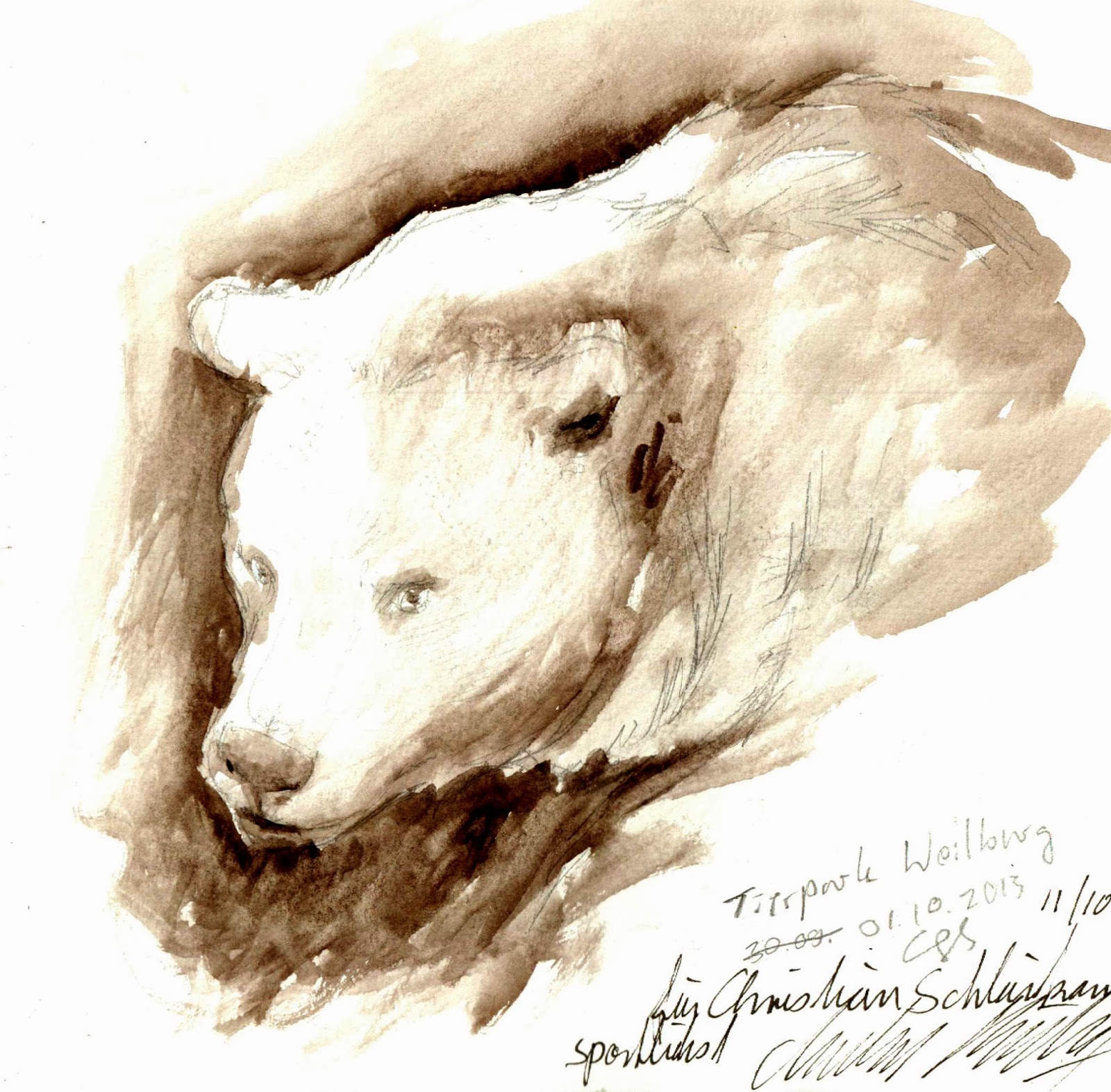
the bear was very close at the animal's enclosure in Weilburg...he made a run after i layed in the first washes >Alas!< The signature in the lower right is by wildlife cameraman Andreas Kieling,  who I bumped into one week later at the bookfair in Frankfurt

Capricorn in Weilburg

finally extensive drawing at the Senckenbergmuseum in Frankfurt; Triceratops

asian Elephant (left) and northamerican Mastodon (right)

cavebear

smilodon

oviraptor

I love the ancient elephants...

and one guy shouldn't miss...although....it's a cast


Donnerstag, 26. September 2013

Interview with Les Edwards

I feel honoured that legendary Fantasy and Science Fiction Illustrator Les Edwards  put his brushes aside for a moment to answer some of my curious questions.
Here they come:

When and why did you make the decision to become a professional illustrator in the field of Fantasy and Science Fiction?
I don't think I ever made a positive decision to become an illustrator. It was a chance that came along and I thought I'd give it a shot. It was believed at my Art School that it was impossible to make a living as an illustrator and so I didn't expect it to last. Then, suddenly, it was twenty years later and people began to talk about my "Career in Illustration"

Les Edwards, "Lovecraft in Britain"


Which themes (e.G. sword and sorcery, weird fiction, Science Fiction etc.) do you enjoy most working on?
What is it that attracts you about them?

Generally I feel most at home working in Horror but the specific genre is not terribly important so long as there is a high level of weirdness. I've always been attracted to the strange and grotesque and I suppose you could say that I've never grown up.

  "Black Charade", Cover for the second book in the Dr. Caspian series by John Burke. Published by Coronet. Les' interpretation of Dr. Caspian inspired German Fantasy author Wolfgang Hohlbein to create victorian researcher "Robert Carter - the warlock of Salem", published with the same cover by Bastei Lübbe, Germany.


When you look back on 40 years of experience in Fantasy-illustration:
what would you say has changed in the meantime within the Genre?
What were the most important twists in the industry from your point of view?

Of course, the introduction of digital technology had a huge effect but the real change is in the success of the genre itself. When I began illustrating there was no "Fantasy Industry" as there is now. You could not describe yourself as a "Fantasy Artist" because no one would understand what you meant. Comics were for kids, Science Fiction was for weirdoes and very few people in the UK had heard of Conan the Barbarian. Michael Moorcock was writing his books about Elric and Dorian Hawkmoon but that was about it. Now Fantasy is everywhere, TV, movies, games and of course endless books about teenage vampires. It's hard to remember that at one time this kind of material was rare. I expect there will eventually be a backlash and Fantasy will fall out of favour. After all, does the world really need another Superhero movie?

There's a huge discussion going on whether young artists should offer traditional painting techniques as well or whether to use right away digital tools to produce their artwork. What's your opinion towards that issue?

You can't escape the digital world and I would expect any young person coming into the field to use digital media. I think it's a shame because my love is painting and, whatever anyone says, there is really no comparison between working with real paint and using a computer. That's just my opinion though, because I have spent a lifetime learning to paint. The reality is that the world is now digital and there is no going back.

"Caverns of the snow witch", Commissioned by Puffin for one of the Fighting Fantasy gamebook series


To research your material, do you use models, maquettes or photographs as visual back up?
I read that you did some of your pieces completely from imagination.
How do you train your visual vocabulary, your imaginative muscles, to do so?

I use a lot of photographic reference. It's very important, if you are painting something that does not exist in reality, to give it a sense of conviction, so photography can be important for lighting, anatomy and real-world details. What I never do is photograph something and just copy the photo. What's the point in that? The most important thing is to draw, and keep on drawing; that's true even for digital artists.

"Heroquest", Copyright © MB Games, 1988. Heroquest was a fantasy role-playing game aimed at kids.


What is your most important advice for aspiring artists and students who want to break into the field? 

Don't expect to get rich.


Thanks a lot for taking the time to answer my questions!

"Triple Zombie", Les Edwards

All picture material in this blog post is courtesy of Les Edwards.

Official website of Les Edwards
 

Mittwoch, 24. Juli 2013

15 years "Chronicles of the Immortals"

LYX Egmont has published a small video about the Wolfgang-Hohlbein get together at the Leipzig bookfair, where I drew a quick Water colour sketch of Dieter Winkler and Wolfgang Hohlbein.
In the video you can see me doing the drawing.
I wasn't quick enough to escape the camera team, so you can see a bit of an interview they did with me in the end.


These are the sketches I did on the event (as posted before):


I have to admit that I feel much more comfortable behind my drawing board than in front of a camera...which I think one can pretty much hear in the vid. ;-P


Previously on "Alles Zeichnen":

Everything Lovecraft 

Direct Link to the video by LYX Egmont on youtube:


Mittwoch, 5. Juni 2013

U1


I had a great day with the team of the strategy-agency diffferent.  I used a small break to sketch the beautiful view. From their rooftop you can see the tracks of line U1 leading over schlesische Straße.

Sonntag, 2. Juni 2013

Momo, Michael Ende and the money-go-round

This year the 40th anniversary of Michael Ende's children book classic "Momo" is being celebrated.


Michael Ende dealt for a long time with philosophical questions about the monetary system especially with  Rudolf Steiner' s and Silvio Gesell's thought system of social threefolding which is based on ideas by Wilhelm von Humboldt, summarized in his 1792 essay "über die Grenzen der Wirksamkeit des Staates" ("the Sphere and Duties of Government (the limits of State Action)").

Ende discussed those ideas already at the beginning of the 1980's in interviews with e.G. the artist Joseph Beuys ("Kunst und Politik") and politician Erhard Eppler ("Phantasie, Kultur, Politik").

In an elaborate documentation of Sat1.Bayern the contemporary relevance of "Momo" is now highlighted, among others with proof of a letter conversation between macro economist Werner Onken and Ende.

Onken wrote an essay interpreting "Momo" in an economical context. He sent his essay to Michael Ende asking wether he was right with his analysis and received the following answer:

"Dear Mr Onken,

Thank you very much for your letter and for sending me your essay! I am very lucky that you understood my book so well, especially concerning it's esoterical and economical background.

By the way, you are the first one to realize that the idea of aging money dwells in the background of my book MOMO. During the last years I had been deeply involved with precisely these thoughts of Steiner and Gesell since I have come to the conviction, that the whole of our cultural question cannot be solved without solving the money problem at the same time or even before.

May I call your attention at this opportunity to the book „Geld und Magie*“ by professor Binswanger, published by Edition Weitbrecht. I believe it could be of great interest to you.
Once again my cordially thanks.

With kind regards

Michael Ende"

As Ende's longtime friend and publisher Roman Hocke states in the documentary: If Michael Ende would hear about the actual discussion and understanding of Momo today he would presumably say:
"Eventually!"


You can find the whole German langauge essay of Werner Onken here

Link to the German language documentary by Sat1.Bayern.

The drawn animations in the film were done by Berlin based illustration/animation artist Danae Diasz


"Geld und Magie" ("money and magic") by Hans Chr. Binswanger: an economical interpretation of Goethe's "Faust"


Donnerstag, 30. Mai 2013

Adolph Menzel on Franz von Lenbach


Adolph Menzel's judgement on art was harsh; the bar he'd raised for himself and his fellow artists was incredibly high.
Some of his hard judgement on the work of his contemporairies is passed on.
According to Joachim von Küremberg his judgement on Franz von Lenbach was as follows:

"Among many irrelevant things there are some rare cliffs that are standing out of the floods! - The main mishap with Lenbach is that he cannot draw, one only has to look at his laces, decoration and uniforms. They are painted completely nonchalant and really lousy! (...) This bavarian Franzl is painting on every tuesday- and friday afternoon a picture of Bismarck after an enlarged photography which he is tracing, then he is painting in the eyes, at the most he's merely sketching in the face and mumbles the rest altogether in a brown sauce; for doing so this barbarian receives thirtythousand marks."

(quoted from Gisold Lammel, "Anekdoten über die kleine Exzellenz", Berlin 1989)


Franz von Lenbach, Bismarck with hat, 1880

In this context I find it plausible and worth mentioning that Menzel is the only painter for whom David Hockney could surely proove in his book "Secret Knowledge: Rediscovering the lost techniques of the Old Masters" that he didn't use photographies or the help of projectors for his drawings.

Wikipedia article on Adolph Menzel

Wikipedia article on Franz von Lenbach

David Hockney's "Secret Knowledge: Rediscovering the lost techniques of the Old Masters" on Amazon


Dienstag, 28. Mai 2013

official partners

I'm thrilled to anounce that I am the official partner of Heel publishing, the German publisher of John Howe's Fantasy Art workshop to give art instruction lessons based on his books.


More infos to follow soon on

http://www.christianschlierkamp.de/teachings_christian_schlierkamp_de.html


Montag, 27. Mai 2013

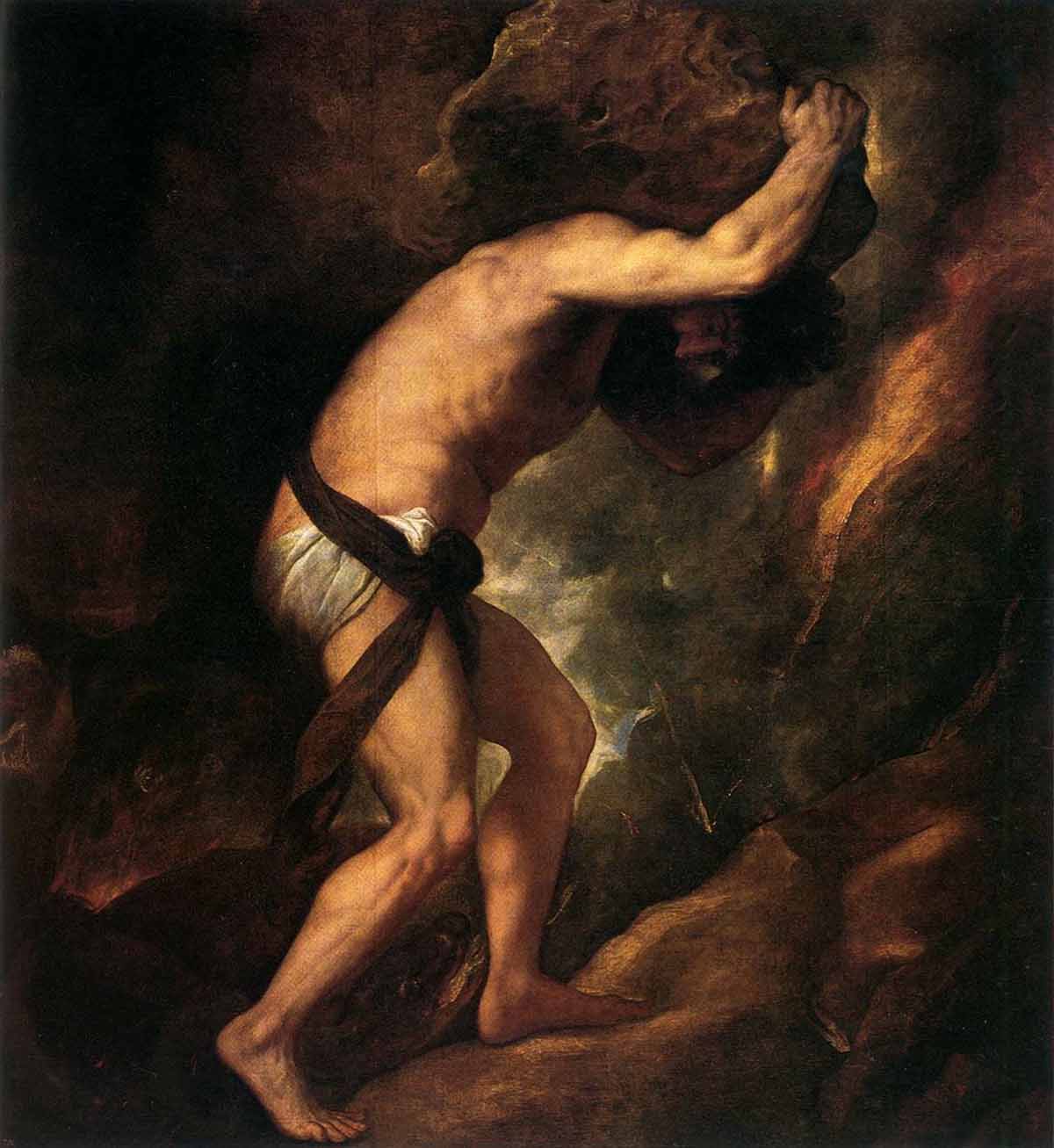
Sisyphus


Sisyphus by Titian, 1548/49


"When Sisyphus comes to understand that it's the process that matters more than the result, he's not doomed anymore."

Michael Ende, "the archaeology of darkness - interviews on art and the work of the painter Edgar Ende", pg 29

"Wenn Sisyphus begreift, daß die Tätigkeit wichtiger ist als das Ergebnis, dann ist er nicht mehr verdammt."

Michael Ende, "Die Archäologie der Dunkelheit - Gespräche über Kunst und das Werk des Malers Edgar Ende", S. 29